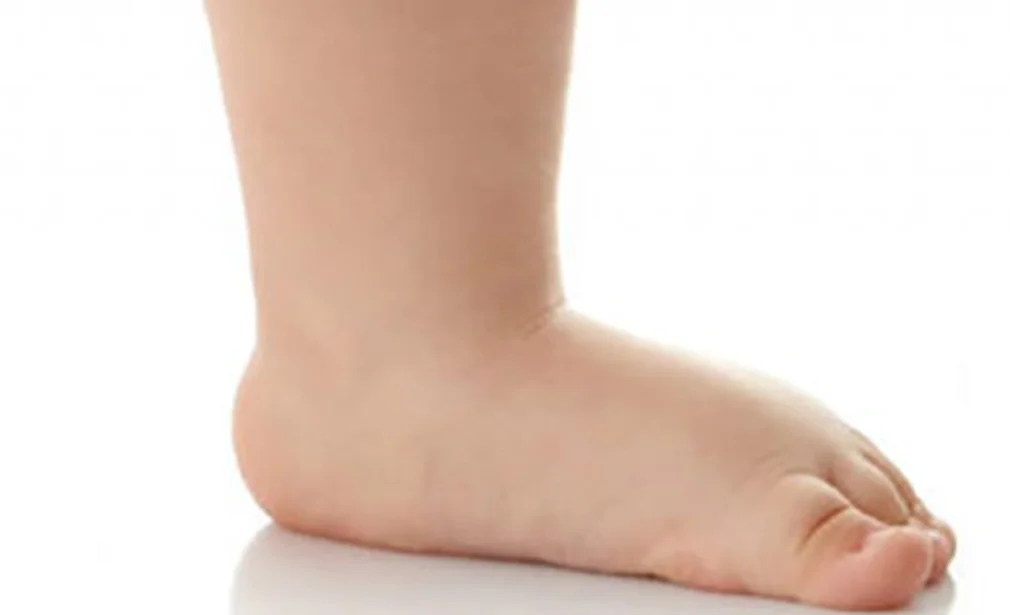
Flexible flat feet (pes planus) is a condition where the arch of the foot disappears when the child stands but reappears when the child stands on their tiptoes or sits with feet off the ground. This flexibility is the hallmark that distinguishes it from rigid flat foot, which is a more serious condition.
Flat feet are normal in children under 3 years of age as the arch develops gradually. In older children, flexible flat feet are a common normal variant — found in 15–25% of adults. The vast majority of children with flexible flat feet are completely asymptomatic and require no treatment.
- Normal developmental variant: All infants have flat feet at birth — the arch develops gradually between ages 3–10
- Ligamentous laxity: Loose ligaments allowing the foot to flatten under body weight — often familial and associated with generalised joint hypermobility
- Genetic predisposition: Strong family history in many cases — if parents have flat feet, children are more likely to as well
- Obesity: Excess body weight can cause or worsen arch collapse
- Tarsal coalition (rigid flat foot): Abnormal bony or cartilaginous connection between two foot bones — causes painful rigid flat foot and needs investigation
- Neurological causes: Cerebral palsy and other neuromuscular conditions can cause flat foot due to muscle imbalance
👶
How does the child present?
- Flat foot appearance when standing — the inner arch touches or nearly touches the ground
- The arch is clearly visible when the child rises on tiptoes (confirming flexibility)
- The heel typically tilts outward (hindfoot valgus) when standing
- Most children are completely painless — flat feet are not inherently painful in children
- Some children complain of aching in the arch, heel, or calf after prolonged walking or physical activity
- Shoes wear out abnormally on the inner side
- Child may avoid walking long distances, sports, or standing for extended periods
🩺
What tests are required?
- Clinical examination — the Jack's toe raise test (arch reappears on tiptoeing) confirms flexibility
- Assessment of the whole lower limb — knee alignment, hip rotation, and generalised ligamentous laxity
- Weight-bearing X-rays of the foot — to assess bony architecture and rule out tarsal coalition in symptomatic or rigid cases
- CT scan or MRI if tarsal coalition is suspected — to identify the type (calcaneonavicular or talocalcaneal)
- Neurological assessment if neuromuscular cause is suspected
💊
What are the treatment options?
- Observation (most cases): Asymptomatic flexible flat feet in children require no treatment — the majority improve spontaneously as the child grows and the arch develops
- Footwear advice: Firm-soled shoes with a stiff counter provide support. Avoiding excessively flat shoes or flip-flops is helpful
- Arch support insoles (orthotics): Custom or over-the-counter insoles can reduce fatigue and pain in symptomatic children — they support the arch during activity but do not permanently correct the deformity
- Physiotherapy: Foot strengthening exercises (towel scrunching, single-leg balance, calf stretches) can improve muscle support of the arch
- Surgical treatment (selected cases only): For painful flat feet that fail conservative treatment in older children — options include calcaneal lengthening osteotomy or subtalar arthroereisis (a small implant placed in the subtalar joint to prevent over-pronation)
- Tarsal coalition resection: If a painful rigid flat foot is caused by tarsal coalition — surgical excision of the coalition relieves pain and restores mobility
🌟
What is the expected outcome?
The vast majority of children with flexible flat feet have an excellent prognosis. Most asymptomatic cases require no treatment and resolve naturally or are well-tolerated into adulthood. Symptomatic flat feet respond well to orthotics and physiotherapy. Surgery is rarely necessary and is reserved for painful, severe cases in older children. The key message for parents: flat feet in children are normal and most do not require treatment.