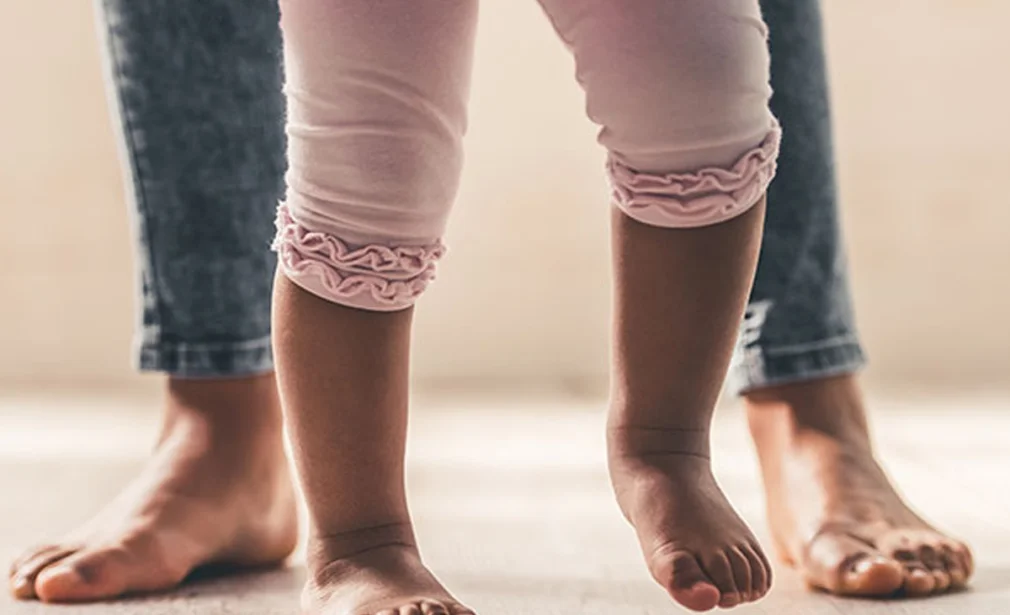
Bow legs is a condition where both knees won't touch each other but both feet will touch together when the child stands. Knocked knees is the opposite — both knees will touch each other but both feet are apart.
These are actually part of normal childhood development. Infants typically show leg bowing until around age 2. Between ages 2–6, children naturally progress to a knock-knee position. By adulthood, most children achieve normal alignment on their own.
While mild bowing and knock-knee is normal in growing children, persistent or severe deformity can result from:
- Metabolic causes — Vitamin D deficiency (Rickets), low phosphate levels affecting bone mineralisation
- Blount's disease — abnormal growth of the inner part of the tibia causing progressive bowing
- Skeletal dysplasia — genetic conditions affecting bone growth
- Growth plate damage — from previous injury or infection near the knee
👶
How does the child present?
- Visible lower limb deformity — legs appear bowed or knees knock together
- Difficulty with activities: running, walking on uneven ground, climbing stairs
- Knee pain or joint discomfort, especially during or after physical activity
- Unusual gait pattern or frequent tripping
- In younger children, parents usually notice the alignment during nappy changes or bath time
🩺
What tests are required?
- Clinical examination of hips, knees, and ankles — assessing alignment, rotation, and range of motion
- Blood tests — Vitamin D3, calcium, phosphate, and alkaline phosphatase levels to rule out metabolic causes
- Full-length weight-bearing X-rays of both lower limbs — to measure the exact degree of deformity and plan treatment
💊
What are the treatment options?
- Observation: For physiological (normal developmental) bowing or knock-knee, careful monitoring until age 7–8 is sufficient as most cases resolve spontaneously
- Medical management: Vitamin D and calcium supplementation when metabolic causes are identified
- Growth modulation surgery (8-guided growth): For younger children with growing bones — small plates placed across one side of the growth plate to guide the bone to grow straight; a minor procedure with quick recovery
- Corrective osteotomy: For older children or adolescents with persistent deformity — the bone is cut, corrected to the right alignment and held with a plate
🌟
What is the expected outcome?
The majority of children with physiological bowing or knock-knees will achieve normal leg alignment naturally without any treatment. For abnormal presentations (Blount's disease, Rickets-related deformity), early detection and timely intervention produces excellent results. Growth modulation in younger children is highly effective with minimal downtime. Corrective osteotomy in older children reliably restores alignment, reduces pain, and prevents future joint arthritis.