Brachial Plexus Birth Palsy (BPBP) is an injury to the brachial plexus — the network of nerves that controls movement and sensation in the arm — occurring during the birth process. It results in weakness or paralysis of the affected arm and hand, ranging from mild to complete.
It occurs in approximately 1–3 per 1,000 live births. The brachial plexus arises from nerve roots C5 to T1 in the neck. Injury to different levels produces different patterns of weakness, with three main types: Erb's palsy (upper roots C5–C6), Extended Erb's palsy (C5–C7), and Global palsy (entire plexus C5–T1).
BPBP results from excessive traction on the neck and shoulder during delivery:
- Shoulder dystocia: The most common mechanism — the baby's shoulder gets caught behind the mother's pubic bone during delivery, causing the neck to be stretched to the opposite side
- Large for gestational age (macrosomia): Larger babies are at higher risk of shoulder dystocia
- Difficult instrumental delivery: Use of forceps or vacuum extraction increasing traction forces
- Breech delivery: Arm entrapment during breech birth
- Prolonged labour: Prolonged second stage increasing risk
- The nerve injury ranges from stretching (neuropraxia — fully recoverable) to tearing (neurotmesis — may require surgery)
👶
How does the child present?
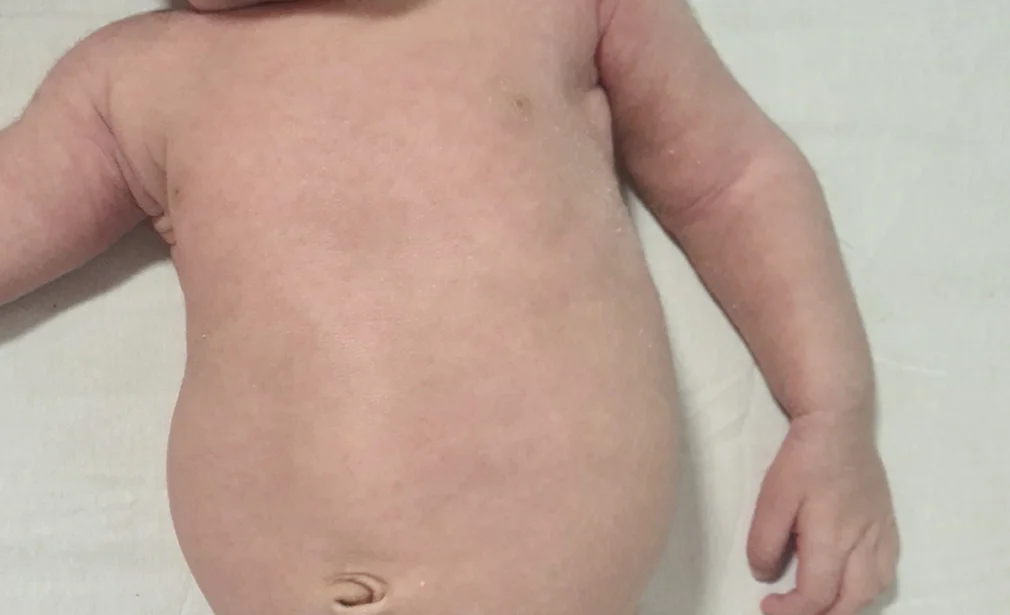
- Erb's palsy (C5–C6): Classic "waiter's tip" posture — arm hangs at the side with the shoulder internally rotated, elbow extended, forearm pronated, wrist flexed. Shoulder and elbow movement is lost; hand grip is preserved
- Extended Erb's palsy (C5–C7): All of the above plus wrist extension weakness
- Global palsy (C5–T1): Complete flaccid paralysis of the entire arm including hand. Associated with Horner syndrome (drooping eyelid, small pupil) indicating severe root avulsion
- Absent Moro reflex on the affected side at birth
- Reduced or absent movement of the affected arm compared to the normal side
- Associated clavicle or humerus fracture in some cases
🩺
What tests are required?
- Clinical neurological examination — documenting muscle power in each muscle group (Modified Mallet Score, Active Movement Scale)
- Serial clinical assessments at 1, 3, and 6 months to track recovery progress
- MRI of the brachial plexus — to identify nerve root avulsions (roots torn from the spinal cord) vs. ruptures (nerve torn between roots and muscles)
- Electromyography (EMG) and nerve conduction studies — to assess nerve continuity and estimate recovery potential
- X-ray of the shoulder — to rule out clavicle fracture or shoulder dislocation
- Ultrasound of the shoulder — to assess dynamic joint stability
💊
What are the treatment options?
- Physiotherapy (from birth): Gentle passive range-of-motion exercises to prevent stiffness and contractures while awaiting nerve recovery. Essential from the first weeks of life
- Occupational therapy: Functional activities to encourage use of the affected arm and develop compensatory strategies
- Botulinum toxin (Botox) injections: For internal rotation contracture of the shoulder — Botox into the overactive internal rotators combined with physiotherapy to improve shoulder positioning
- Brachial plexus nerve surgery (3–9 months if no recovery): If biceps function has not recovered by 3 months (the "3-month rule"), microsurgical nerve reconstruction is considered. Options include nerve grafting (using donor nerve from leg) and nerve transfer (redirecting a functioning nearby nerve). Timing is critical — surgery after 12 months gives poorer results
- Secondary reconstructive surgery: For children with residual weakness at older ages — procedures include shoulder tendon transfers, shoulder derotation osteotomy, elbow flexorplasty, and forearm rotation surgery to optimise function
🌟
What is the expected outcome?
Approximately 70–80% of children with Erb's palsy recover fully or near-fully without surgical intervention. Children with incomplete recovery or global palsy benefit significantly from timely nerve surgery — microsurgical reconstruction restores meaningful function and allows children to lead active, independent lives. Even with residual weakness, secondary reconstructive procedures significantly improve shoulder and elbow function. Early physiotherapy, expert assessment at critical time points, and a coordinated multidisciplinary approach are the keys to maximising every child's outcome.