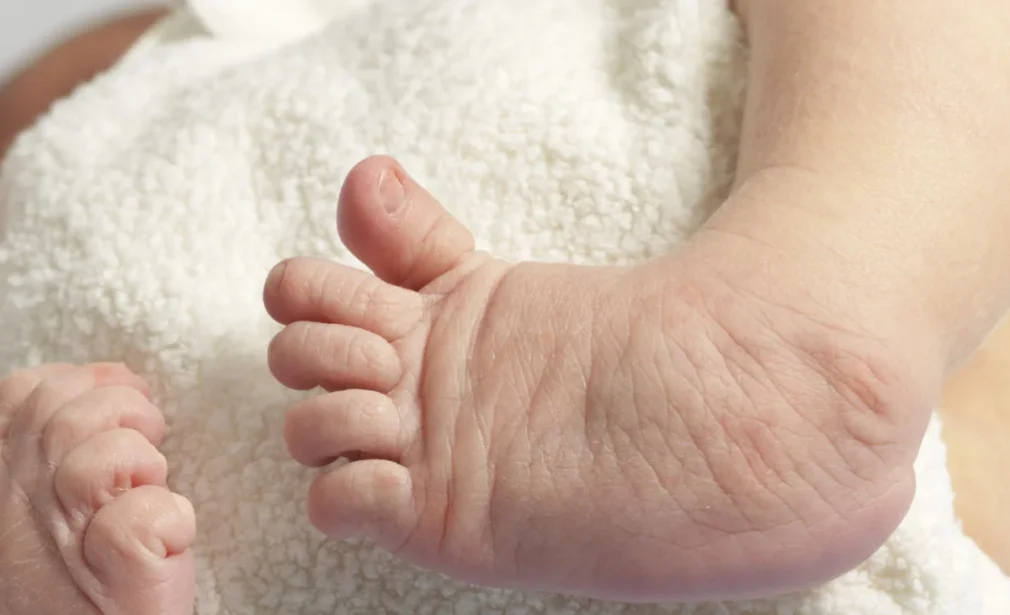
Club foot (medically termed Congenital Talipes Equinovarus or CTEV) is one of the most common congenital musculoskeletal conditions, occurring in approximately 1 in 1,000 live births. The foot is twisted inward and downward — the sole faces inward and the toes point down.
The deformity has four components remembered by the acronym CAVE: Cavus (high arch), Adductus (forefoot turning inward), Varus (hindfoot tilting inward), and Equinus (foot pointing downward). Club foot is bilateral in about 50% of cases and is more common in boys.
- Idiopathic (most common): No identifiable cause in the majority of cases — likely multifactorial with genetic and environmental components
- Genetic factors: Positive family history increases risk — siblings have a 3–4% risk; children of an affected parent have a higher risk
- Neuromuscular conditions: Spina bifida, arthrogryposis, and cerebral palsy can cause secondary club foot (more rigid and harder to treat)
- Intrauterine factors: Oligohydramnios (reduced amniotic fluid) restricting fetal movement
- Club foot can often be detected on routine antenatal ultrasound scan from around 20 weeks of pregnancy
👶
How does the child present?
- Foot visibly twisted inward and downward at birth — often detected by midwife or paediatrician at delivery
- The entire foot from heel to toe is involved — the heel is small and pulled up, the forefoot turns inward
- The calf muscles on the affected side are thinner than on the normal side
- The deformity is rigid — unlike positional deformities, it cannot be passively corrected to neutral position
- If undetected and untreated — as the child begins walking, weight is borne on the outer border of the foot causing painful calluses and severe functional impairment
🩺
What tests are required?
- Clinical examination at birth to confirm diagnosis and assess severity using the Pirani or Diméglio scoring system
- Differentiation from positional club foot (flexible, corrects easily) and postural talipes (corrects with gentle manipulation)
- X-rays are not routinely required initially but may be used to assess bony relationships in older children or atypical presentations
- Ultrasound may assist in very young infants before bones are ossified
- Assessment for associated neuromuscular conditions — spine MRI if neurological cause suspected
💊
What are the treatment options?
Treatment should begin within the first week of life to take advantage of the plasticity of infant ligaments and cartilage:
- Ponseti serial casting (gold standard): A weekly casting programme begins within days of birth. Each cast gently corrects one component of the deformity at a time — cavus first, then adductus and varus, then equinus. Typically 5–7 casts over 5–7 weeks
- Percutaneous Achilles tenotomy: In about 90% of cases, a minor procedure to cut the Achilles tendon is performed after the final cast to fully correct the equinus. The tendon heals and lengthens within the final cast over 3 weeks
- Foot Abduction Brace (FAB): After casting, the child wears a boots-and-bar brace for 23 hours/day for 3 months, then nights and naps until age 4–5. Brace compliance is critical — it prevents relapse
- Tibialis anterior tendon transfer (TATT): For children over 2.5 years with dynamic supination (foot turning inward during walking due to muscle imbalance) — the tendon is transferred to the lateral border of the foot to balance pull
- Surgical soft tissue release: For resistant or relapsed cases not amenable to re-casting — a more extensive posterior medial release may be required
🌟
What is the expected outcome?
The Ponseti method achieves excellent correction in over 95% of idiopathic club feet. Children treated early with full brace compliance grow up with a functional, pain-free, plantigrade foot that fits into normal footwear. They can walk, run, play sports, and lead fully normal active lives. The key to success is starting treatment immediately after birth and maintaining brace wear as prescribed. Relapse rate with poor brace compliance is significantly higher — reinforcing the importance of dedicated follow-up.