Developmental Dysplasia of the Hip (DDH) is a spectrum of conditions where the hip joint does not develop normally — ranging from a mildly shallow acetabulum (socket) to a completely dislocated hip (femoral head entirely outside the socket). The term "developmental" acknowledges that the abnormality may not be present at birth but develops over time.
DDH affects approximately 1–2 per 1,000 live births (frank dislocation) and 1 in 10 births when including milder instability. It is more common in girls (6:1), firstborn children, and those with a positive family history. The left hip is more commonly affected.
- Ligamentous laxity: Maternal hormones (relaxin) cause generalised joint laxity in the newborn — in some infants this affects hip stability
- Breech presentation: Strong risk factor — the extended hip position increases dislocation risk (hips flexed, knees extended)
- Positive family history: 12% risk if a parent has DDH; higher if a sibling is affected
- Oligohydramnios: Reduced amniotic fluid restricts fetal movement and increases mechanical risk
- Firstborn children: The uterine and abdominal wall is tighter in first pregnancies, increasing mechanical pressure on the hips
- Swaddling: Tight swaddling with the hips extended and adducted is a recognised risk factor — hip-healthy swaddling is recommended
👶
How does the child present?
- Newborns: Positive Barlow test (hip dislocatable) or Ortolani test (hip reducible with a "clunk") on clinical examination at birth screening. Often asymptomatic
- Infants (3–12 months): Limited hip abduction on the affected side; asymmetric skin folds around the thigh; shortening of the limb
- Walking age (12–18 months): Limping, painless waddling gait; if bilateral, wide-based waddling gait with lumbar lordosis
- Older children: Painless limp is the most common presentation; Trendelenburg gait (pelvis drops to opposite side when standing on affected leg)
- DDH is painless in childhood — pain and arthritis develop in early adulthood if untreated
🩺
What tests are required?
- Clinical neonatal hip examination (Barlow and Ortolani tests) — performed on all newborns
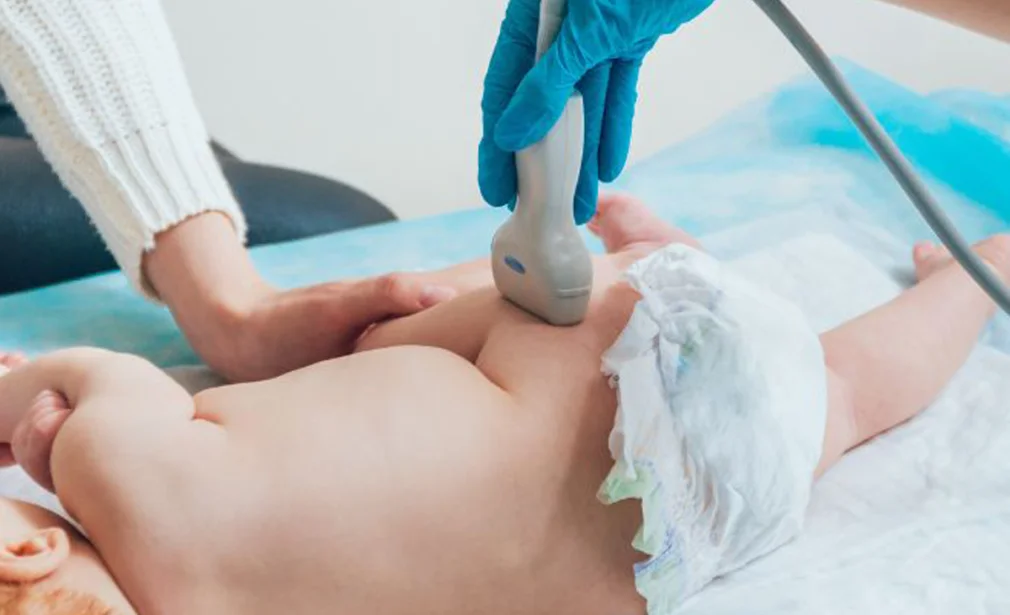
- Hip ultrasound: The investigation of choice in infants under 6 months of age (before the femoral head ossifies). Graf classification of acetabular morphology. Recommended for high-risk infants (breech, family history)
- X-ray of the pelvis: Used from 4–6 months onwards when the femoral head begins to ossify. Shenton's line continuity and acetabular index are assessed
- MRI or CT arthrogram: used before open reduction surgery to assess the joint contents (fat, labrum, ligamentum teres) that may obstruct reduction
💊
What are the treatment options?
Treatment depends entirely on the age at diagnosis — earlier is always better:
- Pavlik harness (0–6 months): A soft dynamic harness that keeps the hips flexed and abducted, encouraging the femoral head to remain in (or relocate into) the socket. Success rate >90% for dislocatable hips when started early. Worn full-time for 6–12 weeks then part-time
- Rigid abduction orthosis: For hips that fail the Pavlik harness or are diagnosed at 4–6 months — a rigid brace provides more stable positioning
- Closed reduction under anaesthesia: For hips diagnosed at 6–18 months or those that fail harness treatment — the hip is reduced under general anaesthesia using arthrography guidance, then held in a hip spica cast for 3 months
- Open reduction (18 months – 3 years and beyond): Surgical incision to remove obstacles preventing reduction (shortened ligaments, fat pad, pulvinar), achieve proper reduction, and reconstruct the acetabulum. Combined with femoral osteotomy in some cases
- Pelvic osteotomy (Salter, Pemberton, Dega): Reshaping the acetabulum surgically to provide better cover over the femoral head — for residual dysplasia after reduction
🌟
What is the expected outcome?
DDH diagnosed at birth and treated with the Pavlik harness has an excellent prognosis — the vast majority of children achieve normal hip development and a pain-free life. The outcome deteriorates with later diagnosis, but surgical reconstruction still achieves good results in experienced hands. Untreated DDH invariably leads to early hip arthritis in young adulthood. The key is universal neonatal screening, early ultrasound for at-risk infants, and prompt referral for specialist assessment.