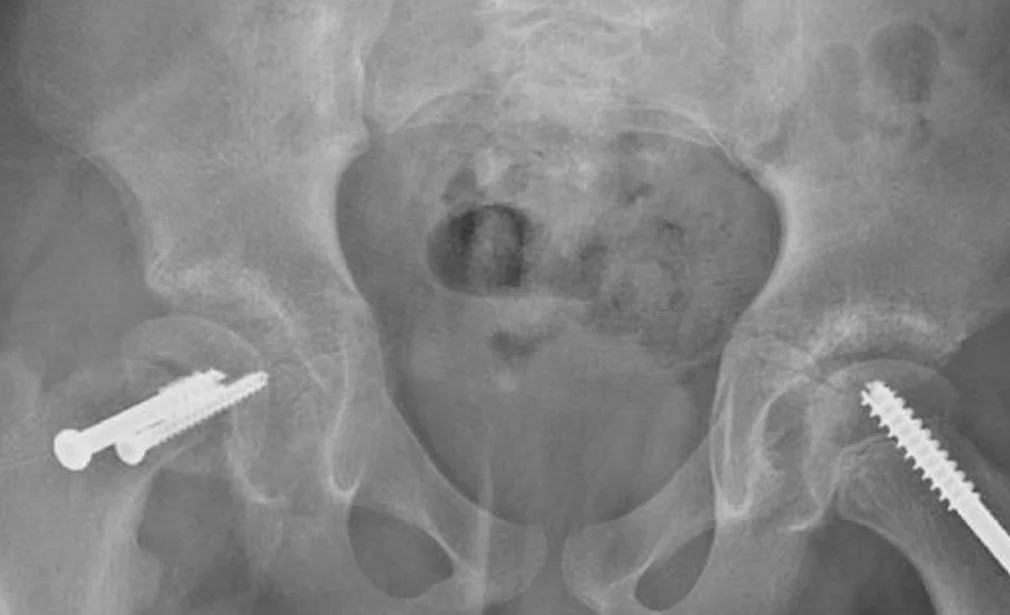
Slipped Capital Femoral Epiphysis (SCFE) is a condition in which the femoral head (the ball of the hip) slips backward and downward off the top of the femoral neck through the growth plate (physeal plate) during adolescence. Think of it like a scoop of ice cream slipping off a cone.
It is the most common hip disorder in adolescents, typically occurring between ages 10–16 during the pubertal growth spurt when the growth plate is vulnerable. It is more common in boys and in overweight children. It can be stable (child can still walk with or without crutches) or unstable (child cannot bear weight — this is a surgical emergency with a high risk of avascular necrosis).
- Obesity: Excess mechanical load on the growth plate during the pubertal growth spurt — the most significant risk factor. The growth plate is weakened by the rapidly changing hormonal environment and cannot withstand the increased shear forces
- Hormonal factors: Endocrine disorders including hypothyroidism, growth hormone deficiency, and hypogonadism weaken the growth plate and predispose to SCFE — endocrine workup is mandatory for atypical SCFE (young child, thin child, bilateral)
- Rapid growth: The pubertal growth spurt weakens the physis (growth plate) making it susceptible to slippage
- Increased femoral retroversion: Subtle anatomical variation in hip geometry increasing shear forces
- Bilateral SCFE occurs in 20–40% of cases — the opposite hip must always be monitored or prophylactically pinned
👶
How does the child present?
- Hip, groin, thigh, or knee pain — knee pain alone is common and frequently leads to delayed diagnosis (knee is examined, hip is missed)
- Limp — antalgic (pain-avoiding) gait; in chronic SCFE the child has had a limp for weeks to months
- External rotation of the leg — the affected leg turns outward when the child walks or lies down
- On examination: Drehmann sign — when the hip is flexed, it obligatorily externally rotates (cannot flex without rotating out)
- Limited hip internal rotation and flexion
- Unstable SCFE: Child cannot bear any weight — severe pain, the leg lies in external rotation. This is an orthopaedic emergency
- Typically an obese adolescent boy, age 12–14
🩺
What tests are required?
- X-ray of the pelvis (AP and frog-lateral views): The definitive investigation. Klein's line (a line along the superior femoral neck) should intersect the femoral head — if it doesn't, a slip is present. The frog-lateral view is essential as mild slips can be missed on the AP alone
- Severity grading: mild (<33%), moderate (33–50%), severe (>50%) slip based on percentage displacement
- MRI: for pre-slip (symptomatic hip with normal X-ray) and to assess avascular necrosis in unstable SCFE
- Blood tests: thyroid function (TSH), growth hormone levels, testosterone/oestrogen — for atypical presentations
- X-ray of the opposite hip — to detect contralateral pre-slip or early SCFE
💊
What are the treatment options?
All SCFE requires surgical treatment — once diagnosed, the child should be admitted and made non-weight-bearing immediately pending surgery:
- In-situ screw fixation (stable SCFE — standard treatment): A single cannulated screw is placed across the growth plate in the exact position of the slip — perpendicular to the physis. The screw stabilises the slip and closes the growth plate to prevent further slippage. The slip is not reduced — attempting to reduce a chronic stable slip risks avascular necrosis
- Urgent reduction and pinning (unstable SCFE): Gentle reduction under anaesthesia followed by 2-screw fixation — performed as an emergency within 24 hours. The risk of avascular necrosis remains significant even with prompt surgery
- Prophylactic contralateral pinning: The opposite hip is pinned at the same operation in high-risk cases (young age, endocrine disorder, obesity) to prevent a second slip
- Subtrochanteric osteotomy / modified Dunn procedure: For severe slips causing significant deformity — a more complex corrective procedure to restore normal femoral head/neck alignment; performed at specialist centres
- Post-operative management: Non-weight-bearing for 6 weeks, followed by gradual return to activity. Regular follow-up until skeletal maturity
🌟
What is the expected outcome?
Stable SCFE treated promptly with in-situ screw fixation has excellent results — the growth plate fuses, further slipping is prevented, and the vast majority of children lead normal active lives. The risk of early hip arthritis depends on the severity of the slip at diagnosis — mild slips do very well; severe slips have a higher long-term arthritis risk. Unstable SCFE carries a significant risk of avascular necrosis (up to 50%) even with optimal surgical care. Early diagnosis is the most important factor — any limping adolescent with hip, groin, or knee pain must have hip X-rays.