
As children learn to stand, walk, and run, parents in Nungambakkam often pay close attention to how their child's legs look. Is it normal for a 15-month-old toddler's knees to curve outwards? Why do a 4-year-old's knees knock together when running?
Understanding the difference between bow legs (genu varum) and knocked knees (genu valgum) helps parents distinguish normal childhood growth development from conditions that require expert pediatric orthopedic care. In this comprehensive guide, Dr. Vigneshwaran P explains what every parent in Nungambakkam needs to know.
The Normal Growth Progression of Leg Alignment
Childhood leg alignment follows a predictable natural evolutionary curve from infancy through early grade school:
- Infants & Toddlers (0 to 2 Years) — Physiological Bowing: Babies are born with outward-curving legs due to tight positioning inside the womb. Mild bow legs are expected and normal during early walking.
- Ages 2 to 3 Years — Neutral Alignment: The legs naturally straighten out as muscle tone and weight-bearing mechanics mature.
- Ages 3 to 6 Years — Physiological Knocked Knees: The legs overshoot slightly, resulting in inward-slanting knees where the ankles stay apart when knees touch.
- Ages 7 to 10 Years — Adult Alignment: The knees gently align into normal, straight adult angles (typically 5 to 7 degrees of valgus).
— Dr. Vigneshwaran P
Bow Legs (Genu Varum): Physiological vs Pathological
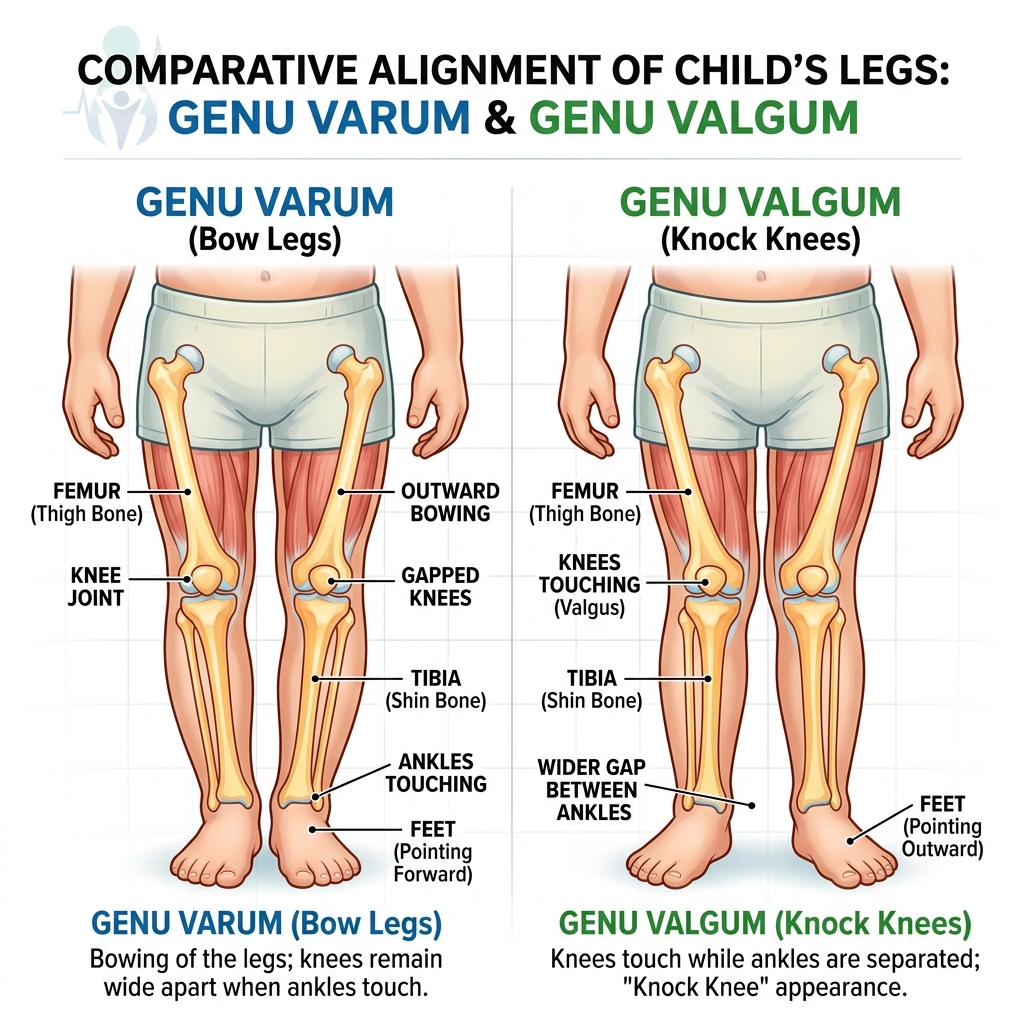
In a child with bow legs, the knees curve outward while the feet and ankles touch together.
Physiological Bowing
Affects both legs symmetrically, is painless, and naturally resolves by age 2 to 2.5 without braces or special shoes.
Pathological Bow Legs (When to Seek Treatment)
If bowing worsens after age 2, affects only one leg, or causes a limp, underlying non-physiological causes must be evaluated:
- Nutritional Rickets: Vitamin D or calcium deficiency leading to soft, bending bones.
- Blount's Disease (Tibia Vara): A growth disorder of the inner aspect of the upper shin bone growth plate.
- Skeletal Dysplasias or Previous Growth Plate Injury.
Knocked Knees (Genu Valgum): What Parents Should Watch
In a child with knock knees, the knees touch each other while standing, but the ankles remain separated by a noticeable gap.
While peak physiological knock knees occur around age 3 to 4, red flag signs requiring clinical review include:
- Ankle gap greater than 8 to 10 cm when knees are touching.
- One leg leaning inward significantly more than the other (asymmetry).
- Frequent tripping, difficulty running, or knee/hip discomfort after playing.
- Persistence of prominent knock knees past 7 to 8 years of age.
How Pediatric Orthopaedic Specialists Evaluate Leg Alignment
During a consultation at Sai Eswar Ortho Kids Care (located right next door to Nungambakkam in Choolaimedu), Dr. Vigneshwaran performs:
- Gait Analysis & Visual Alignment Measurement: Checking the intercondylar (knee gap) and intermalleolar (ankle gap) distances.
- Standing Full-Length Radiographs (EOS / Scannogram): Measuring exact mechanical axis angles when pathological causes are suspected.
- Blood Work: Checking serum Vitamin D, calcium, and alkaline phosphatase levels.
Treatment Options: Non-Surgical & Guided Growth
When medical intervention is necessary, modern pediatric orthopedics prioritizes gentle, minimally invasive solutions:
- Medical Management: Vitamin D & calcium therapy for rickets.
- Observation & Monitoring: Serial photography and clinical alignment mapping every 6 months.
- Guided Growth Surgery (Eight-Plate Technique): For severe or persisting deformities in growing children. A tiny 1.5 cm incision allows temporary tensioning of one side of the growth plate, permitting the child's natural growth to gently straighten the leg over 6 to 12 months with minimal recovery time.
Book an Assessment Near Nungambakkam
If you live in Nungambakkam and are concerned about your child's walking posture or leg shape, expert evaluation is close by in Choolaimedu.
Sai Eswar Ortho Kids Care
📍 104/56, Bajanai Koil Street, Choolaimedu, Chennai – 600094 (Near Nungambakkam High Road)
📞 Call: +91 95511 98650 | +91 87785 71186
💬 WhatsApp: +91 95511 98650
Frequently Asked Questions
Are bow legs normal in toddlers under 2 years old?
Yes. Mild bow legs (genu varum) are a normal part of physiological development in infants and toddlers under 2 years. As children begin walking, their leg alignment naturally straightens out by age 2 to 3.
When should parents in Nungambakkam worry about knock knees in children?
Parents should seek a pediatric orthopedic evaluation if knock knees are severe, asymmetric (affecting one leg more than the other), associated with pain or tripping, or persist beyond age 7 to 8.
What causes severe or non-resolving bow legs in children?
Pathological bow legs can stem from Vitamin D deficiency (Rickets), Blount's disease (growth plate abnormality at the top of the shin bone), or previous trauma to the growth plate.
How are severe bow legs or knock knees treated in pediatric orthopedics?
Treatment ranges from observation and Vitamin D supplementation for metabolic causes to minimally invasive guided growth surgery (eight-plate technique), which gently corrects limb alignment as the child grows.